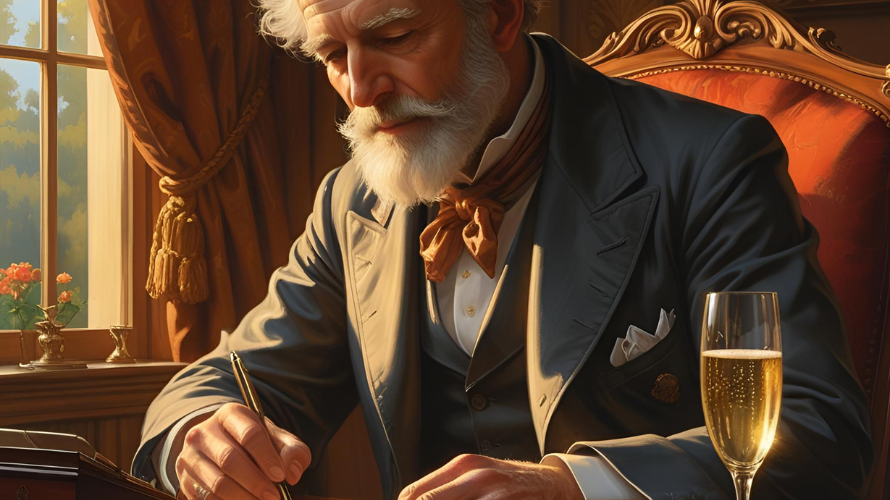
This poetic love letter to bubbles was born from an entirely insignificant conversation with a friend the other day about a situation that made absolutely no sense. “Ours is not to reason why…” I found myself saying. The words just tumbled out, as they have so often over the years. But this time, they stayed with me. That line from Tennyson’s Charge of the Light Brigade sent me spiralling – in the best way.
Before I ever sipped champagne, I was already in love with words – especially Tennyson’s.
At twelve years old, I was that kid. I spent my lunchtimes hidden in the library, reading the grand masters while the other kids played outside. I was utterly captivated by The Lady of Shalott – her mirror, her mystery, her yearning to touch a world just beyond reach. That poem transported me. It made me feel like beauty and longing could live side by side – and that perhaps that was the point.
All these years later, I still find myself returning to that poetic lens – and realising how often champagne feels the same. Full of memory. Brimming with emotion. Fleeting and extraordinary.
And so I found myself wondering:
If Tennyson ever wrote about champagne, what would he say?
This blog is my answer. A poetic love letter to Tennyson and champagne, written by the girl who once lived in poems – and now speaks in bubbles.
The Shared Language of Tennyson and Champagne
Great champagne, like great poetry, moves us.
Tennyson’s recurring themes – memory, hope, the bittersweet ache of beauty that doesn’t last – echo through the ritual of opening a bottle. The sigh of the cork. The shimmer in the glass. The hush before the toast. It’s a rhythm I’ve come to revere.
There’s a quiet connection between bubbles and verse – both crafted with precision, both shaped by time, both capable of lifting the spirit or softening the sorrow.
“Drink, for the world is full of care, But let the stars rise in your glass.”
(An imagined Tennyson toast, if ever there was one.)
If Tennyson Had Written About Champagne…
As someone who speaks champagne fluently – and once spoke poetry fluently, too – I couldn’t resist imagining how Tennyson might have put bubbles to verse.
Here are a few lines I like to think he might have offered:
- “Better to have sipped and sparkled than never to have sipped at all.”
- “Hope smiles from the corked-up years, and whispers, ‘Pop again tomorrow.’”
- “And in the bubbling gold I see / The ghost of every toast and glee.”
- “The Moët murmurs in its mirth; / No finer verse than joy’s rebirth.”
- “Let champagne be your confidante.”
Each line a little ode – to memory, to delight, to the beauty in what won’t last forever (and perhaps because of that, matters all the more).
The Poetry of a Pour
To open a bottle of champagne is to step into a kind of ceremony.
There’s the cold curve of the bottle in your hand. The gentle tension of the cork. The sigh as it’s released. The sound of bubbles rising – like the opening lines of a poem that promise something beautiful.
It’s no wonder champagne is saved for beginnings and endings. For vows and partings. For the moments where ordinary words fall short.
When I poured Bollinger La Grande Année 2015 at Madame Bollinger’s Garden Party last year, I watched the room pause – the kind of pause only poetry or great champagne can command. In that silence, I thought: Tennyson would have toasted this, too.
Why Champagne Deserves Its Laureate
Both champagne and poetry are:
- Crafted with care and tradition
- Able to awaken memory and stir emotion
- Celebrated, yet quietly introspective
- Gifts best shared – but sometimes best savoured alone
Tennyson gave us language for what we often feel but cannot say. Champagne gives us the moment to feel it.
“Tears, idle tears, I know not what they mean.”
– Tennyson, The Princess
(…but I suspect a glass of Krug might help.)
A Toast to the Poetic Life
Those quiet library lunchtimes with The Lady of Shalott weren’t a detour – they were a doorway. I didn’t know it then, but poetry was already shaping how I would move through the world – how I’d come to pause, to celebrate, to seek meaning.
Now, I find myself blending the two – poetry and wine – memory and effervescence. Because both invite us to pause. Both are rituals of beauty. Both remind us that even what is fleeting can be deeply meaningful.
So pour a glass. Whisper a line. And if the bubbles echo something back? Perhaps champagne, like poetry, is listening.
“Pour a glass, calm your mind… and let champagne be your confidante.”